



























Saviour or Devil, India Must Engage With AI: Industry, Government, and Global Experts at the Ahmedabad Dialogue Call for Impact Over Pilots

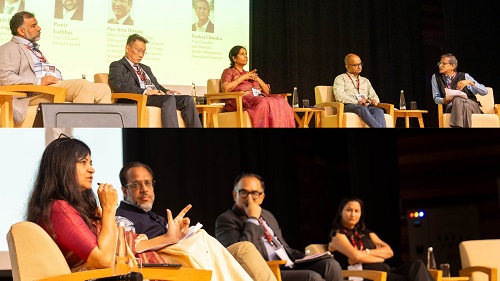


Twenty years. That is how long it once took to develop a new grade of aircraft-engine material. The goal was to bring it down to five, with artificial intelligence at the heart of the effort. The story, shared by Gopichand Katragadda, CEO of Myelin Foundry and former Group CTO of Tata Sons, captured the spirit of the third Ahmedabad Dialogue hosted by Ahmedabad University: AI matters when it changes what is possible, not when it is bolted on to business as usual.


|
|
Ahmedabad Dialogue: AI for Productivity, Public Value, and Resilience
Held on the theme “AI for Productivity, Public Value and Resilience,” this day-long Ahmedabad Dialogue brought together leaders from industry, government, academia and public health to ask a pressing question: if AI is so powerful and pervasive, why are so few Indian businesses and public systems getting real value from it—and what will it take to change that?
Manufacturing, Skilling, and Supply Chains
For P. Bharathi, Secretary, Science and Technology, Government of Gujarat, the question is no longer whether to adopt AI. “AI is compulsory. I mean, we have to live with it,” she said. The missing link, she emphasised, is talent and skilling. The Government of Gujarat is targeting 500,000 young people for AI skilling this year, offering support of up to Rs 50,000 per student, establishing a dedicated Taiwan desk to learn from its semiconductor ecosystem, and preparing a state AI governance policy.
Punit Lalbhai, Vice Chairman, Arvind Limited, described the work required to make AI productive in an industrial setting. Arvind is midway through a 24-month effort involving what he called “very grinding” work on data quality and enterprise-system reconfiguration, so that its data is ready for inference and productivity gains. “Whether it be saviour or devil, one has to be engaged with it, because not engaging with it is a huge risk of being left behind,” he said.
Lalbhai said talent is available, but bringing AI specialists and manufacturing teams together remains a challenge. “It is a Mars and Venus challenge. This AI talent that comes in is a different species from the manufacturing talent that we have.” He predicted that organisations would move from valuing knowledge to valuing ideas, and then to thinking big and collaborating.
Moderating the plenary on manufacturing, technology, supply chains and skilling, Ahmedabad University Vice Chancellor Professor Pankaj Chandra highlighted the gap between AI’s promise and its adoption. AI adoption in Indian manufacturing stands at around 15 per cent; only about 5 per cent of MSMEs have integrated AI into core operations, while 71 per cent identify a lack of employee training as their biggest barrier. “Most businesses buy AI licences probably out of FOMO and without having a digitised shop floor, clean data, or even standardised workflows,” he said. The deeper issue, Chandra argued, is cultural, “We have become too accustomed to throwing people at problems… It is more of a mindset shift than a size-of-prize or cost-consciousness issue.”
Katragadda, founder of Myelin Foundry and former Group CTO of Tata Sons, urged companies to stop treating AI as a showcase. Pilots, he said, are often “a way of saying that we also do AI” and rarely target the areas that matter most. “If you do business as usual and use AI to improve productivity… that is only going to give you ten per cent impact. You need to restructure your business.” He cautioned organisations against waiting for perfect data: “You will not get clean data; you will not get more data. And with the present generation of AI, we can do without that.”
On India’s position, Katragadda said the constraint was not talent but funding, particularly early-stage funding. He urged India to “go ahead of the world in the applications” and proposed a “seventy-twenty-ten” division of horizons: industry looks three years ahead, academia five or more, and government funds what will matter seven years from now.
Professor Pao-Ann Hsiung, Dean, College of Engineering, National Chung Cheng University, Taiwan, traced TSMC’s success to the combined strength of its supply chain, education, and government. AI, he said, is now extending that advantage to smaller firms: “The high-end, or the precise machines that TSMC employs, can now be done by medium and small enterprises because of AI.” He also cautioned against expecting AI to solve every problem. A gap between 72 per cent and 92 per cent, he noted, “is not solvable by AI. So, we need expertise in the field.” For countries building semiconductor capacity, he added, fabrication plants are only part of the task; the supply chain is the bigger challenge.
Health and Sustainability
The plenary on AI for health and sustainability, moderated by Minal Pathak, Academic Director of The Climate Institute at Ahmedabad University, examined both the opportunities and the responsibilities involved in applying AI to people and the planet.
Dr Anunaya Jain of Ahmedabad-based Jhpiego, who leads health-sector AI implementation across more than 30 countries, reported a four-fold reduction in treatment interruptions among HIV patients in Nigeria following the deployment of a predictive model.
Dr Arindam Ray of the Gates Foundation described India’s eVIN network, which tracks vaccine stock and cold-chain temperatures at nearly 30,000 points in fifteen-minute intervals. Dr Shweta Agarwala of Ahmedabad University shared how she used AI to discover a skin-compatible electrode material for a textile-based muscle-atrophy treatment for ICU patients. The panel also addressed AI’s energy and water footprint, data bias, unclear accountability, and the fragility of “human in the loop” safeguards.
Dr Arunabha Ghosh, former CEO of the Council on Energy, Environment and Water Ghosh cautioned that progress depends on how society defines it: “It’s not AI’s problem, it’s our own thinking of what progress means that will be fundamentally holding us back.” Jain recalled a first deployment in which the model’s predictions were accepted 99 per cent of the time and warned that human oversight “succeeds only if humans have the time, the required skill, and the required authority” to disagree. The greatest health gains, he said, come not from the model itself but from the intervention that follows it. Agarwala called for an “AI life assessment,” modelled on product life-cycle assessment, so that each new use of AI is weighed against the resources it consumes.
The Ahmedabad Dialogue’s central message was that meaningful AI value will come from tackling important problems and having the courage to restructure how work is done—not from a scattering of pilots designed to show that an organisation “also does AI.” The groundwork is often unglamorous: clean data, digitised workflows, and disciplined change management. India’s advantage will depend on people who can bridge AI skills with deep knowledge of the factory floor, the hospital ward, and the climate system. As adoption grows, governance must keep pace with questions of accountability, transparency, intellectual property and explainability. The next test is to take promising health and climate solutions that currently work as pilots and make them work across entire systems and, ultimately, across the country.
The Ahmedabad Dialogue is an annual forum hosted by Ahmedabad University, bringing together researchers, policymakers, industry leaders, and practitioners from India and across the world to examine questions shaping India and the region’s development. This year’s edition focused on harnessing AI for productivity, public value, and resilience.