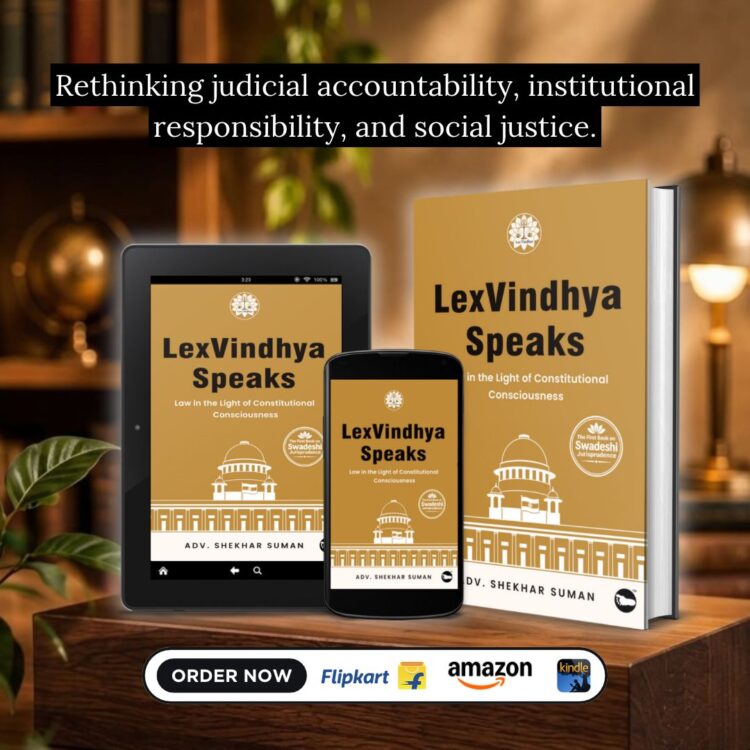
Book Review | ‘LexVindhya Speaks: Law in the Light of Constitutional Consciousness’ by Shekhar Suman
What makes a law just? Is it enough for a law to be enacted by a competent authority, or must it also reflect the realities, aspirations and collective consciousness of the people it governs? These questions lie at the heart of LexVindhya Speaks: Law in the Light of Constitutional Consciousness, a thought-provoking work by Shekhar Suman that invites readers to reconsider the foundations of law, justice and constitutional governance in India.
Rather than approaching law merely as a collection of statutes, judicial precedents and institutional procedures, Shekhar explores its deeper relationship with human existence, society, nature and collective consciousness. The book’s central proposition is that law should not be understood simply as an instrument of authority or punishment; its ultimate purpose should be to regulate competing interests, remove injustice and restore equilibrium in society.
The most distinctive contribution of the book is its proposition towards what the author calls Swadeshi Jurisprudence. Importantly, the term does not advocate rejecting foreign legal philosophies or abandoning comparative legal thought. Instead, it calls for developing an Indian jurisprudential perspective rooted in the country’s historical experiences, social realities, cultural diversity and constitutional aspirations. Drawing upon the contributions of jurists such as John Austin, Jeremy Bentham, Friedrich Savigny, H. L. A. Hart and Lon Fuller, the author attempts to move the discussion beyond established definitions of law and examine why law becomes necessary in the first place.
One of the book’s most interesting conceptual contributions is the idea of the Content of the Soil. The expression goes beyond geographical territory to encompass the accumulated experiences, historical memories, natural conditions, social relationships and collective aspirations of a people. Through the metaphor of the Constitutional Tree, Shekhar presents the Constitution as a living institution rooted in human consciousness, sustained by constitutional values and expected to produce the fruits of justice, liberty, equality and dignity. The metaphor offers an accessible way of understanding why constitutional principles must remain connected with the society in which they operate.
Equally significant is the author’s understanding of justice through the principle of equilibrium. According to Shekhar, differences between individuals and communities are not necessarily injustices. Problems emerge when one interest or exercise of power unjustifiably obstructs another. Law must therefore identify the obstruction and introduce an appropriate counterforce to restore balance. This counterforce, however, must remain proportionate; a remedy that eliminates one injustice while creating a greater one defeats its own purpose. The proposition gives the familiar Scale of Justice a deeper philosophical meaning.
The book subsequently moves from theoretical jurisprudence to contemporary constitutional and social concerns. Its discussions include women’s security, domestic violence, dowry-related deaths, judicial accountability, institutional responsibility, criminal impunity and the relationship between political power and constitutional limitations. In Women’s Security as a Constitutional Frontier, the author argues that women’s safety must be treated as a fundamental constitutional concern rather than merely an issue of routine law enforcement. Similarly, the chapter on preventing domestic violence and dowry deaths calls for a shift from punishment-centred approaches towards preventive constitutionalism, emphasising awareness, legal literacy and community participation.
Another noteworthy dimension is the book’s engagement with religious identity and universal human consciousness. Chapters such as The Light of Ram and Muhammad, Universal Consciousness, Religious Identity, and the Constitutional Crisis of Human Division and Two Paths, One Source explore the possibility of ethical and spiritual coexistence beyond narrow institutional and communal divisions. By bringing different religious traditions into philosophical conversation, the author attempts to emphasise shared values such as compassion, truth, justice and human dignity. These discussions add an unusual interdisciplinary dimension to a work primarily concerned with law and constitutional thought.
Shekhar also turns his attention to the legal profession itself. In From Noble Profession to Constitutional Stewardship, he questions whether professional excellence should be measured only through commercial success or whether public service, constitutional commitment and access to justice deserve greater recognition in judicial appointments. This discussion raises an important question about the responsibilities of advocates in a constitutional democracy.
One of the strengths of LexVindhya Speaks is its willingness to ask uncomfortable questions about institutions that are often discussed only in terms of their formal authority. The author repeatedly reminds readers that constitutional institutions derive their legitimacy not merely from their existence but from their conduct. A Constitution cannot fulfil its promises through written provisions alone; its values must be reflected in the everyday functioning of the legislature, executive and judiciary.
Ultimately, LexVindhya Speaks is not simply an examination of what law is; it is an inquiry into what law ought to accomplish. Its central message is that legal authority must remain accountable to human dignity, constitutional morality and the realities of society. By proposing Swadeshi Jurisprudence, Shekhar Suman makes an attempt to bring Indian experience into the centre of jurisprudential inquiry without closing the doors to universal legal thought.
In an age when discussions about law frequently revolve around power, political disagreements and institutional authority, this book offers an opportunity to return to a more fundamental question: what is the purpose of justice? Its answer lies in the restoration of equilibrium, where competing interests can coexist without unjust domination.
The book leaves readers with a significant thought: a legal system should not be judged solely by the power it exercises, but by the justice it delivers and the human dignity it preserves. That is perhaps the most compelling reason to engage with LexVindhya Speaks.
rss_feed
Disclaimer:This content is sourced from syndicated feeds, PR agencies, or brand submissions. Views expressed are those of the respective authors, and we do not independently verify them..