Shyna, Fazilka:A historic shift has arrived in India’s rural employment policy. The Central Government has officially notified the Viksit Bharat – Guarantee for Rural Employment and Livelihood Mission (Gramin), popularly called the VB–G RAM G Act, 2025, which will come into force across all rural areas of the country from 1 July 2026. From the same date, the Mahatma Gandhi National Rural Employment Guarantee Act (MGNREGA), which has supported millions of rural families since 2005, will stand repealed.
The new law is designed not merely as a relief programme but as an ambitious initiative aimed at creating productive assets and aligning rural development with the vision of Viksit Bharat @2047.
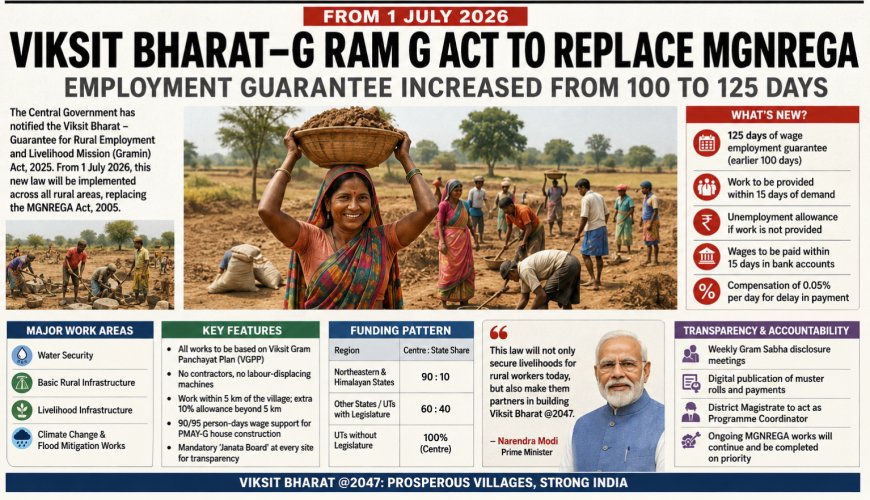
The biggest reform under the new Act is the increase in guaranteed employment from 100 days to 125 days per financial year for every rural household. This statutory guarantee will be available to all rural families whose adult members are willing to undertake unskilled manual work voluntarily.
Existing MGNREGA job card holders whose e-KYC has been completed will continue to remain valid until new Rural Employment Guarantee Cards are issued.
Employment must be provided within 15 days of demand. If work is not provided within that period, workers will be entitled to an unemployment allowance — at least one-fourth of the notified wage rate for the first 30 days and at least half thereafter.
Wages will be paid weekly or within 15 days of closure of the muster roll through Direct Benefit Transfer (DBT) into workers’ bank or post office accounts. In case of delay, compensation at the rate of 0.05% per day will be payable.
Smooth Transition from MGNREGA to VB–G RAM G
The Government has clarified that the transition from MGNREGA to VB–G RAM G will be smooth and disruption-free. All works ongoing under MGNREGA as of 1 July 2026 will continue under the new Act and will be completed on priority to avoid leaving public assets unfinished.
To ensure there is no reduction in employment during the transition phase, adequate labour budgets have been allocated to all states and Union Territories.
Attendance at worksites will be recorded using face authentication technology, though alternative arrangements will be available in areas facing network or technical issues.
As far as possible, employment will be provided within a 5-kilometre radius of the applicant’s village. If work is allotted beyond that distance, workers will receive an additional 10% of the wage rate towards transportation and living expenses.
Focus on Productive Assets and Rural Planning
A key feature of the new Act is its emphasis on works related to four major sectors:
Water security
Basic rural infrastructure
Livelihood-related infrastructure
Climate change mitigation and flood management works
The engagement of contractors will remain strictly prohibited, and labour-displacing machinery will not be allowed.
All projects must emerge from the Viksit Gram Panchayat Plan (VGPP) — a convergence-based and participatory development plan prepared by Gram Panchayats and approved by Gram Sabhas. This ensures that local needs remain at the core of planning.
The Act promotes a “single-plan, multi-financing” approach, allowing convergence with Central, State, and local government schemes.
Under the PMAY-G housing scheme, labour support of 90/95 person-days for house construction can also be availed under this Act.
Transparency and Accountability Measures
At the district level, the District Magistrate (or an equivalent officer nominated by the state government) will function as the District Programme Coordinator, while Block Development Officer-level officials will act as Programme Officers at the block level.
Gram Panchayats will continue to play a central role in registration, execution of works, record maintenance, and planning.
Every worksite must display a “Janata Board” containing details of the project, estimated labour-days, quantity of materials, and item-wise expenditure.
Gram Panchayats will hold weekly disclosure meetings, while muster rolls, payments, approvals, and other key indicators will be publicly disclosed both digitally and physically.
At the district level, material expenditure cannot exceed 40% of total expenditure.
Funding Pattern and Special Provisions
The funding pattern under the new Act has been structured as follows:
90:10 between Centre and State for Northeastern and Himalayan states
60:40 for other states and Union Territories with legislatures
100% Central funding for Union Territories without legislatures
Until revised wage rates are notified, existing MGNREGA wage rates will continue.
To ensure labour availability during peak agricultural seasons such as sowing and harvesting, state governments may notify periods during which work under the Act will not be undertaken.
During natural disasters, the Central Government may grant special relaxations on the recommendation of state governments, including expansion of permissible works, increased wage employment, and relaxation in documentation requirements.
Building the Foundation of a Developed India
Through the Viksit Bharat–G RAM G Act, the Government aims to convey that every rural worker is not only entitled to livelihood security today but is also a builder of tomorrow’s developed India.