

































Beyond The Comfort Of Success — A Spotlight On Author & Leader Sashank Jajala

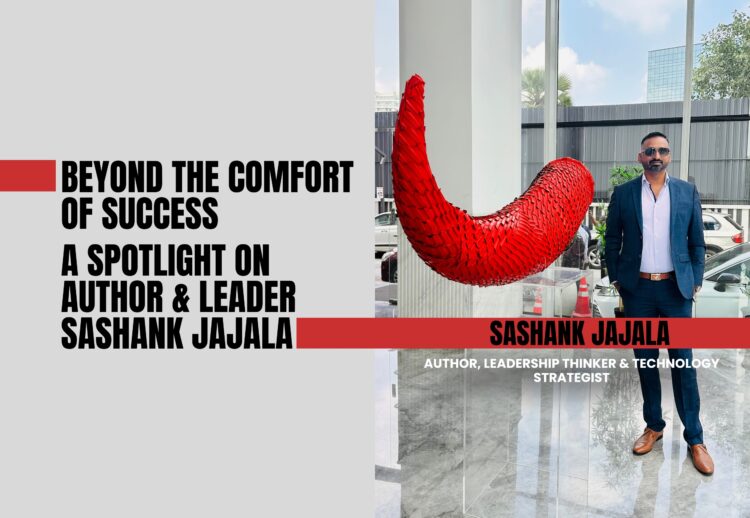


Sashank Jajala is a writer, thinker, and senior technology and leadership practitioner whose work occupies a rare and valuable space at the intersection of strategic intelligence, organisational wisdom, and deeply human insight. He is not a theorist who has studied leadership from the comfortable remove of an academic institution; he is someone who has lived leadership, in all its complexity and contradiction, across the full breadth of the global organisational contexts. Along with that the book he has written offers the extraordinary and immediately practical value to the leaders, aspiring leaders, and the thoughtful professionals who are navigating the very real and specific challenges of remaining relevant, adaptive, and genuinely effective in this dynamic world.


His professional journey is one defined by consistent and ambitious engagement with the most complex and consequential dimensions of organisational life. Sashank’s work spans the interconnected disciplines of leadership evolution, organisation design, and operating model transformation at genuine enterprise scale. What distinguishes him most clearly from the many practitioners who work in adjacent spaces is his rare capacity to bridge the three territories that so often remain frustratingly disconnected in large organisations: strategy, systems, and the irreducibly human dimension of leadership. It is this bridging capacity of Sashank that gives his thinking its distinctive quality and his writing its particular power and practical relevance.
A defining chapter of Sashank Jajala’s professional story has been written at Wärtsilä, the globally renowned technology group where he has spent well over a decade demonstrating his capabilities as a senior leader at the forefront of technology transformation and digital performance. The depth and duration of his tenure at Wärtsilä speaks eloquently to both the quality of his contribution and the breadth of the trust and responsibility he has been accorded. Over more than ten years of senior leadership in an environment that demands both strategic vision and the operational excellence, Sashank has accumulated a body of lived experience that reaches into virtually every dimension of the challenges, which his book explores. As, he talks about the experience of navigating the organisations through significant transformation, and of recognising the precise moment when stability begins to shade into the risk that holds it back from its next evolution.
It is this rich and genuinely hard-won body of professional experience that provides the living foundation of “Leadership After Success: Leadership When Stability Becomes The Risk!” A book that arrives as one of the most refreshing, honest, and practically useful contributions to the leadership literature in recent years. The book’s central premise is as counterintuitive, upon reflection that success itself can prevent the next phase of growth, when it is not navigated with a particular quality of awareness and intellectual honesty. In addition, Sashank Jajala names this dynamic with a deep clarity and a precision that immediately resonates with anyone who has spent time in a leadership role, and he explores its dimensions with the kind of honest as well as unsparing analysis.
What gives “Leadership After Success” its particular distinction within the crowded landscape of the leadership literature is not merely the quality of its central insight; but also, the manner in which that insight is developed, illustrated, and translated into practical application. On top of that Sashank writes with a clarity and a directness that strip away the jargon and complexity that so often make leadership books feel more impressive than useful. The book’s exploration of concepts such as alignment, subtraction, and the critical leadership transition from expert to explorer are rendered not as abstract theoretical constructs but as living, recognisable realities. The real-life examples of three very different leaders that anchor the book’s central arguments make its core message concrete and unmistakably relevant, demonstrating with compelling clarity that competence alone is not sufficient to guarantee either growth or adaptability in the face of genuine organisational and personal change.